

Why Peptides Matter in Modern Drug Discovery
Peptides sit in a distinctive space between small molecules and large biologics. Their specificity, structural versatility and sequence-level design make them valuable research tools—and explain why drug discovery keeps returning to them.
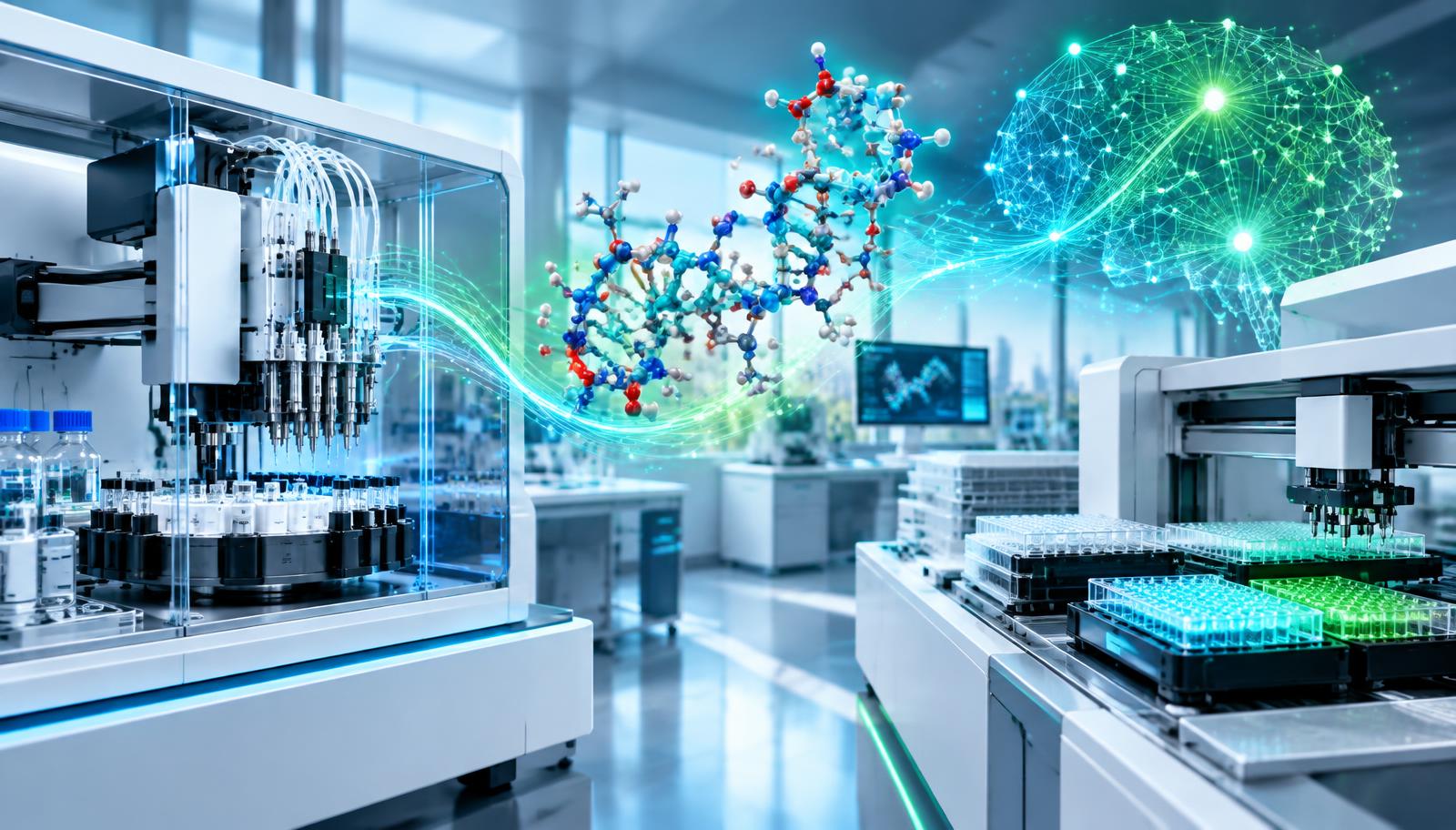
Peptides occupy a distinctive position in modern drug discovery. They are built from amino acids like proteins, yet many are small enough to be produced and modified with chemical methods. That combination gives researchers a useful design space: molecules that can recognise biological targets with precision while remaining highly adjustable at the sequence level.
A useful middle ground between small molecules and biologics
Small-molecule drugs are compact and often excellent at entering cells, while large biologics such as antibodies can recognise complex targets with exceptional selectivity. Peptides occupy part of the space between those two classes. The European Medicines Agency describes synthetic peptides as being at the interface of small molecules and proteins, which is one reason they require their own quality and manufacturing considerations.
Specific molecular recognition is a major strength
One of the most frequently cited advantages of peptides is their ability to bind selected targets with high affinity and specificity. A peptide presents several amino-acid side chains across a defined three-dimensional surface, allowing multiple molecular contacts at once. In research, that can help distinguish a desired target from closely related alternatives. High specificity is not the same thing as guaranteed clinical safety, but it is a powerful property during molecular design and target validation.
Peptides can address broader binding surfaces
Many important biological interactions occur across relatively broad protein surfaces. These interfaces can be difficult for a very small molecule to occupy effectively. Peptides are larger and conformationally flexible enough to reproduce parts of a natural interaction surface, which makes them especially interesting for studying receptors, signalling complexes and protein–protein interactions that may be difficult to approach with conventional small molecules.
Sequence-level design makes peptides unusually modular
A peptide sequence can be changed one residue at a time. Researchers can compare related sequences, replace selected amino acids, introduce cyclisation, attach chemical groups or explore non-canonical residues. This makes peptides a practical platform for structure–activity research: a change in sequence can be linked to a change in binding, stability or another measurable property. The molecule becomes both the subject of the experiment and a tunable design system.
Biology already provides a rich starting vocabulary
Peptides are deeply embedded in biology as signalling molecules, hormones, receptor ligands and fragments of larger proteins. That does not mean every biological peptide becomes a useful medicine. It does mean researchers often begin with molecular interactions that already exist in nature, then investigate whether a sequence can be reproduced, stabilised, modified or used as a probe to understand a pathway more precisely.
Modern engineering is tackling the classic weaknesses
Peptide research is attractive partly because its limitations are well defined. Many peptides can be broken down rapidly by enzymes, cleared quickly from circulation or struggle to cross cell membranes. Current research uses several engineering strategies to address those problems, including cyclisation, lipidation, conjugation, non-canonical amino acids and specialised delivery approaches.
- Sequence modification can reduce susceptibility to selected proteases or change how a peptide interacts with its target.
- Cyclisation can restrict molecular flexibility and may improve stability for some designs.
- Lipidation and other conjugation strategies can alter distribution or extend exposure for selected peptide classes.
- Display technologies, computational modelling and automated synthesis allow larger numbers of candidate sequences to be explored systematically.
Analytical quality is part of the science, not an afterthought
A sophisticated sequence is only useful if researchers know what material they are actually studying. Identity, purity, related impurities, water content and other quality attributes can influence interpretation. The EMA guideline for synthetic peptides recommends robust analytical characterisation and notes that peptide identity may require at least two orthogonal methods. For research materials, strong documentation therefore supports better experiments: it connects a biological result to a material that has been meaningfully characterised.
What has changed in peptide discovery?
The field now combines chemistry with high-resolution analytics, display libraries, automation and computational tools. Recent reviews describe how these technologies can broaden candidate discovery and help researchers prioritise sequences before committing to more expensive experimental work. Artificial intelligence can contribute predictions and ranking, but it does not replace synthesis, analytical confirmation or biological testing.
Why the field remains scientifically exciting
The strongest case for peptides is not that they are universally better than small molecules or biologics. It is that they offer a different set of capabilities. Their molecular recognition, accessible sequence design and compatibility with modern engineering methods give researchers another way to interrogate biological systems and pursue targets that may be difficult for other modalities.
Research context: molecular promise, analytical quality and preclinical findings are not the same as clinical proof. A peptide can be scientifically valuable in laboratory research without having established safety or efficacy for use in people.
The bigger picture
Peptide science has moved from a specialist chemistry problem into a broader discovery platform connecting synthesis, analytics, computation and biology. That combination explains the sustained interest: researchers can start from biological recognition, redesign the sequence, measure the consequences and iterate. The result is not a shortcut to a medicine, but a versatile framework for asking increasingly precise scientific questions.
Related products
See allFrequently asked questions
Why are peptides useful in drug discovery?
They combine specific molecular recognition with sequence-level flexibility. Researchers can design, modify and compare related peptides while studying how those changes affect measurable properties such as binding or stability.
Are peptides better than small molecules?
Not universally. Small molecules, peptides and biologics each have different strengths. Peptides are particularly useful when their size, binding surface and modular sequence provide an advantage for the target being studied.
What is the biggest challenge with peptide-based drug candidates?
Common challenges include enzymatic degradation, rapid clearance and limited membrane permeability. Modern peptide engineering focuses heavily on improving these properties.
Does a promising research peptide automatically become a medicine?
No. Laboratory activity and analytical quality are only parts of a much longer development process. Clinical safety and efficacy require appropriate human studies and regulatory review.
Why does analytical testing matter for peptide research?
Because researchers need confidence in the identity and quality of the material behind an experimental result. Analytical characterisation helps distinguish the intended peptide from related impurities and other sources of uncertainty.
Sources and further reading
- PubMed — Pharmaceutical Peptides: From Synthesis and Mechanistic Pharmacology to Future Biologic Therapeutics
- International Journal of Molecular Sciences — Therapeutic Peptides: Recent Advances in Discovery, Synthesis, and Clinical Translation
- Biomacromolecules — Peptides as Targeting Agents and Therapeutics: A Brief Overview
- WIREs Computational Molecular Science — Revolutionizing Peptide-Based Drug Discovery: Advances in the Post-AlphaFold Era
- European Medicines Agency — Guideline on the Development and Manufacture of Synthetic Peptides
About the author
Synedica Research Desk
Scientific content team
The Synedica Research Desk writes and maintains the technical library behind the Synedica Europe catalogue. The team compiles publicly available literature, supplier documentation and analytical data into plain-language explainers for laboratory and research audiences.
- Reviews certificates of analysis supplied with every Synedica batch
- Sources claims from peer-reviewed literature and regulator publications
- Publishes review dates and correction notes on every article
Continue reading
See all
What Are Research Peptides? A Plain-English Guide
Peptides sit between amino acids and proteins. Here is what that means in practice, how research-grade material is produced and how to read what is printed on the vial.
Peptide Purity and HPLC, Explained
Two vials can both claim 99% purity and contain measurably different amounts of peptide. This explains why.

How Peptide Research Moves From Bench to Regulator
Understanding the pipeline explains why 'in research' and 'approved' are separated by years and by an enormous amount of evidence.
The Future of Peptide Discovery: Automation, Synthesis and AI
The next chapter in peptide discovery is not simply about making more molecules. It is about connecting design, synthesis, measurement and learning so that each experiment informs the next. Automation and AI can strengthen this cycle, provided the evidence remains traceable and experimental validation stays central.