

The Future of Peptide Discovery: Automation, Synthesis and AI
The next chapter in peptide discovery is not simply about making more molecules. It is about connecting design, synthesis, measurement and learning so that each experiment informs the next. Automation and AI can strengthen this cycle, provided the evidence remains traceable and experimental validation stays central.
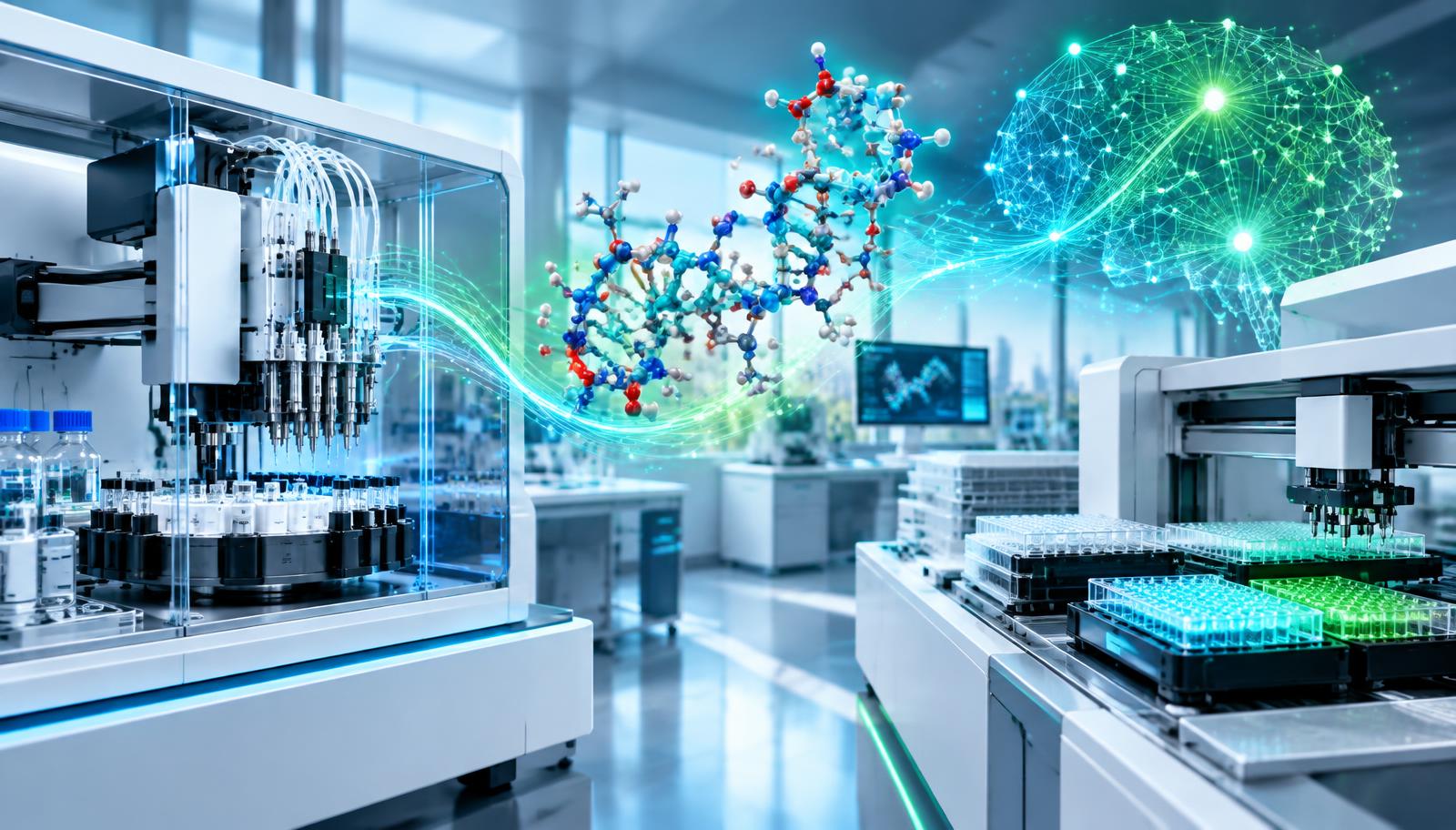
Discovery as a learning cycle
Peptide research involves choices: which sequence to investigate, which structural features to vary and which measurements will answer the scientific question. The design–make–test–learn framework connects these choices. Researchers propose candidates, produce them, measure relevant properties and use the results to revise their ideas. Its value lies less in any individual technology than in the quality of the connections between stages. A faster instrument helps little if its output cannot inform the next decision.
Peptides offer considerable scope for molecular variation, but not every interesting design is practical to produce or useful to investigate. Discovery therefore requires balancing several properties rather than optimising a single score. The Nature Reviews Drug Discovery reference provides a broader context for trends in peptide drug discovery; here, the focus is the experimental research process, not clinical performance. Reference: Nature Reviews Drug Discovery — trends in peptide drug discovery (https://www.nature.com/articles/s41573-020-00135-8).
Automation connects making and measuring
Automated synthesis can reduce repetitive handling and make programmed operations easier to record consistently. When connected to sample tracking and analytical workflows, it can also help researchers compare candidates without losing their experimental history. Yet automation does not remove the underlying chemistry. Different sequences can present different synthesis, solubility or purification challenges. A machine completing its programmed work is not, by itself, evidence that the intended peptide has been obtained with the characteristics required for interpretation.
Screening automation extends the same principle to measurement: coordinated instruments can organise samples and collect comparable observations across a series. The opportunity is a more coherent workflow, not merely a larger collection of numbers. The cited Nature Communications work concerns automated peptide synthesis; it should not be read as proof that every peptide or laboratory task is ready for unattended operation. Reference: Nature Communications — automated peptide synthesis (https://www.nature.com/articles/s41467-025-62344-2).
- Connect every result to an unambiguous sequence, any modifications and the physical sample that was measured.
- Preserve analytical checks and sample history alongside screening results, rather than storing them in disconnected files.
- Make controls, repeat measurements and exceptions visible when comparing candidates.
- Define which decisions can be automated and which require scientific review before the cycle continues.
What computational prediction can contribute
Computational methods can help prioritise candidates before synthesis. Depending on the question and available data, they may estimate molecular properties, explore possible structures or rank sequences for experimental testing. AI can learn patterns across recorded examples, while other modelling approaches use explicit physical assumptions. These tools are complementary rather than interchangeable. A prediction about conformation does not automatically establish binding, and predicted binding does not establish a biological effect in an experimental system.
An especially useful role for AI is helping choose the next informative experiment. In an active-learning approach, a model is updated as new measurements arrive and suggests candidates that may improve performance or reduce uncertainty. This remains a research strategy, not a guarantee of discovery. It needs a clearly defined objective and safeguards against repeatedly selecting familiar sequences. Sometimes the most valuable candidate is one that tests the model's assumptions rather than one with the highest predicted score.
Data quality sets the limits
A model cannot reliably compensate for ambiguous experimental records. Sequence notation, chemical modifications, measurement units and assay context all affect what a result means. A value measured in one system may not be directly comparable with the same nominal endpoint measured elsewhere. Without this context, pooling datasets can create apparent patterns that reflect laboratory differences rather than peptide behaviour. Data quality therefore includes provenance and comparability, not simply the absence of blank fields.
Evaluation also needs to reflect the intended task. If closely related sequences appear in both training and test datasets, a model may seem more capable of generalising than it really is. Testing on genuinely distinct candidates can provide a more demanding assessment. Unsuccessful synthesis attempts and inactive candidates also matter: excluding them can make the recorded research landscape misleadingly favourable. Their interpretation still requires care, because an inconclusive measurement is not the same as a confirmed negative result.
Editorial note: AI-generated sequences, predicted structures and computational scores are research outputs, not validated biological findings. Confidence estimates may also be unreliable for chemistry unlike the training data. Claims should remain proportionate to the model's evaluation and to the experimental evidence available.
Validation closes the loop
Experimental validation asks whether a prediction survives contact with a real sample and an appropriate measurement. Establishing sample identity and analytical quality supports interpretation; it does not establish biological activity. Biological observations require suitable controls, reproducibility checks and, where appropriate, a second method that probes the question differently. An apparent signal may otherwise reflect interference or another feature of the measurement system. Feeding these distinctions back into the dataset is what turns testing into learning. Results from experimental research should not be presented as evidence of benefit in people.
An accessible future, grounded in documentation
A useful future need not mean a fully autonomous laboratory. Shared data conventions, interoperable instruments and clearly documented models can make connected research more accessible, although cost and specialist expertise remain constraints. Progress will depend on transparent handovers between people, software and instruments, with researchers retaining responsibility for interpretation. The optimistic outlook is better-informed experimentation, not certainty on demand. To explore the surrounding science and available documentation, visit Synedica's research library and documented catalogue.
Related products
See allFrequently asked questions
Will AI replace peptide researchers?
AI can support candidate selection and pattern recognition, but researchers still define meaningful questions, assess experimental limitations and interpret unexpected results. Automation changes how work is organised; it does not remove scientific responsibility or the need for judgement about what a measurement actually demonstrates.
Does automated synthesis guarantee a suitable research sample?
No. Automation executes and records defined operations, but the resulting material still needs appropriate analytical assessment. Sequence-dependent chemistry, purification and sample handling can affect interpretation. Completing an automated synthesis run is different from confirming the identity and quality of the sample used in an experiment.
What makes an AI prediction scientifically useful?
A useful prediction addresses a clear question, states its limitations and can be checked experimentally. Evidence is stronger when evaluation avoids overlap with training examples and when prospective tests examine previously unmeasured candidates. Even then, conclusions remain specific to the properties and experimental systems actually studied.
Sources and further reading
About the author
Synedica Research Desk
Scientific content team
The Synedica Research Desk writes and maintains the technical library behind the Synedica Europe catalogue. The team compiles publicly available literature, supplier documentation and analytical data into plain-language explainers for laboratory and research audiences.
- Reviews certificates of analysis supplied with every Synedica batch
- Sources claims from peer-reviewed literature and regulator publications
- Publishes review dates and correction notes on every article
Continue reading
See all
From Manual Synthesis to Digital Platforms: How Peptide Science Evolved
Peptide science advanced through successive changes in what researchers could build, measure and compare. From early synthetic chemistry to connected laboratory platforms, its history is one of expanding experimental possibilities—not a shortcut from a manufactured molecule to a clinically validated intervention.

What Are Research Peptides? A Plain-English Guide
Peptides sit between amino acids and proteins. Here is what that means in practice, how research-grade material is produced and how to read what is printed on the vial.

How Peptide Research Moves From Bench to Regulator
Understanding the pipeline explains why 'in research' and 'approved' are separated by years and by an enormous amount of evidence.