
Peptide Packaging Science: Barriers Against Light, Moisture and Oxygen
For experimental peptide research, packaging is part of the stability question, not simply a protective shell. Glass, closures, headspace and outer layers work together, and their contribution becomes meaningful when the complete configuration is evaluated over time.
The package is a connected system
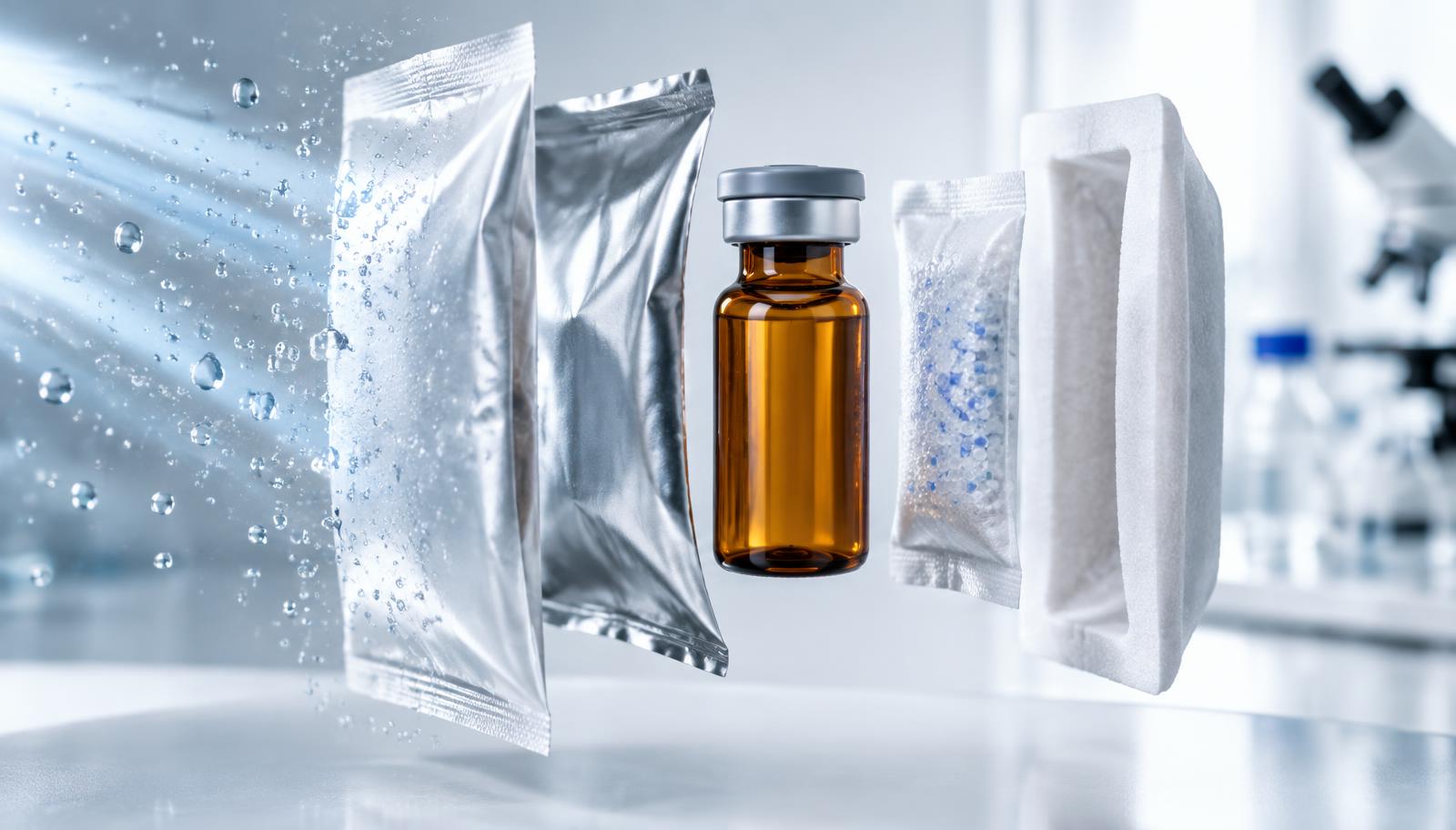
A peptide container does more than hold material. It establishes an interface between the sample and its surroundings, influencing exposure to light, water vapour and oxygen. The relevant unit is therefore the container-closure system: the vial, stopper and securing components considered together. Secondary packaging can add another barrier, but it cannot automatically compensate for an unsuitable seal or an incompatible contact material.
Two distinctions make this science easier to interpret. First, a barrier reduces a particular exposure; it does not establish that every degradation pathway is controlled. Second, a component specification is not the same as evidence for the assembled package. Material properties matter, but so do dimensions, contact surfaces and the way components fit together. Stability belongs to a defined sample in a defined packaging configuration.
Glass and colour: useful, different protections
Glass provides a substantial barrier to water vapour and gases through the vial wall. That does not make a glass vial hermetic: the closure and its interfaces remain relevant. Nor is glass chemically interchangeable across all applications. Its composition and surface characteristics can affect compatibility with the contents. For a peptide solution, interactions at the contact surface may complicate interpretation of a falling measured concentration.
Amber glass can reduce transmission of some wavelengths, but colour alone does not establish adequate photoprotection. The important questions concern the light reaching the sample and whether that peptide, in that formulation, is sensitive to it. A clear vial inside a suitably protective outer pack may also benefit from a light barrier. However, protection supplied by the outer layer exists only while that layer remains in place.
The stopper and headspace complete the picture
A stopper is both a contact material and part of a seal. Its fit, formulation and interaction with the vial influence performance. Container-closure integrity concerns unintended leakage through the assembled system; permeability concerns molecular transport through a material. These are related but different questions. Evidence against a gross leak does not, by itself, quantify gradual moisture or oxygen ingress, or establish compatibility between the stopper and the sample.
Headspace is the gas volume above the contents. Its initial oxygen level can influence the starting environment, yet oxygen may also be dissolved in a liquid or enter later. An inert-gas headspace is therefore not equivalent to demonstrated oxygen protection throughout a study. Moisture needs similar care: a freeze-dried research sample can contain residual water, and susceptibility depends on both the material and its formulation, not appearance alone.
Secondary packaging has a defined job
Outer packaging can provide functions that the primary container does not deliver alone. An opaque carton may limit light exposure; a suitable sealed overwrap may restrict moisture or oxygen exchange. Desiccants and oxygen absorbers have finite capacity and require an appropriate surrounding barrier. Their presence is not proof of performance. A useful assessment assigns each layer a specific purpose and distinguishes the protection of the intact pack from conditions after opening.
- Light: identify whether protection comes from the glass, a sleeve or the outer pack, and whether the relevant configuration was actually evaluated.
- Moisture: distinguish residual water in the sample from water that can enter through closure materials, interfaces or an outer packaging seal.
- Oxygen: consider the initial headspace, oxygen already present in the contents and possible ingress over time rather than one isolated measurement.
- Mechanical protection: consider whether handling or transport could disturb the vial-closure assembly, because barrier performance depends on the package remaining intact.
Stability studies connect design to evidence
A meaningful stability study evaluates representative material in the proposed packaging configuration, with its components and sample state documented. Long-term observations and accelerated conditions answer different questions; accelerated results do not automatically predict a research peptide’s lifetime. If the purpose is to compare a stopper, vial or overwrap, the study needs a comparison that can distinguish the packaging change from differences in formulation, starting quality or environmental exposure.
Editorial note: ICH Q1A(R2) provides a pharmaceutical stability framework, not validation of any particular experimental research peptide or package.
The analytical picture should match the proposed risks. Appearance or identity alone cannot establish stability. Depending on the material, informative observations may include peptide content, degradation products, moisture and relevant physical changes, alongside package integrity or headspace measurements. Methods need to distinguish the intended peptide from meaningful changes. Light sensitivity deserves a separate question rather than an assumption based on a thermal study. Conclusions remain bounded by the configurations, conditions and duration actually examined.
Explore the evidence behind the container
Packaging science offers a constructive way to turn broad promises of protection into specific, answerable questions. The strongest account explains what each barrier is intended to do and where supporting observations begin and end. To continue exploring these distinctions, visit Synedica’s research library and documented catalogue, considering the available information for each material rather than inferring performance from the appearance of its vial.
Related products
See allFrequently asked questions
Does amber glass make a peptide light-stable?
No. Amber glass can reduce exposure to some wavelengths, but light stability concerns the material in its actual configuration. Glass transmission, the peptide’s sensitivity and any outer protection all matter; colour is not a stability result.
Can a sound closure still allow gradual moisture ingress?
Yes. Absence of an unintended leak and resistance to water-vapour permeation are different properties. A closure can have good physical integrity while its materials still permit some molecular transport over time.
Do results transfer automatically to a different vial or stopper?
No. A component change can alter exposure, contact interactions or sealing behaviour. Existing data may inform an assessment, but their applicability to the changed system needs a scientific justification rather than an assumption.
Sources and further reading
About the author
Synedica Quality & Compliance Desk
Quality assurance and compliance team
The Quality & Compliance Desk maintains Synedica Europe's authentication programme, packaging standards and European distribution documentation, and reviews every editorial page that touches handling, storage or regulatory topics.
- Owns the Synedica anti-counterfeit programme (scratch QR, holographic seal, NFC)
- Maintains batch traceability and packaging specifications
- Reviews all handling, storage and shipping guidance before publication
Continue reading
See all
How to Store Research Peptides
Dry, cold and dark, opened as few times as possible. Everything else is detail — but the detail is where material is lost.

Peptide Shelf Life and Stability
Shelf life is a function of chemistry and storage, not a number printed on a box. Here are the pathways that actually consume a vial.

Quality in Transit: Designing Logistics for Sensitive Research Materials
For sensitive research materials, transport is part of the quality story, not an interval outside it. Route assessment, qualified packaging, meaningful monitoring and documented handovers can turn an uncertain journey into an interpretable record. The objective is not simply arrival, but evidence that supports an informed assessment on receipt.