
Inside Lyophilisation: How a Solution Becomes a Stable Dry Material
Lyophilisation is more than removing water. It transforms a frozen solution into a porous solid through controlled phase changes. Understanding the formulation matrix, drying stages and remaining moisture explains both the promise of this approach for research materials and the limits of what appearance alone can reveal.
1. A transformation, not simply evaporation
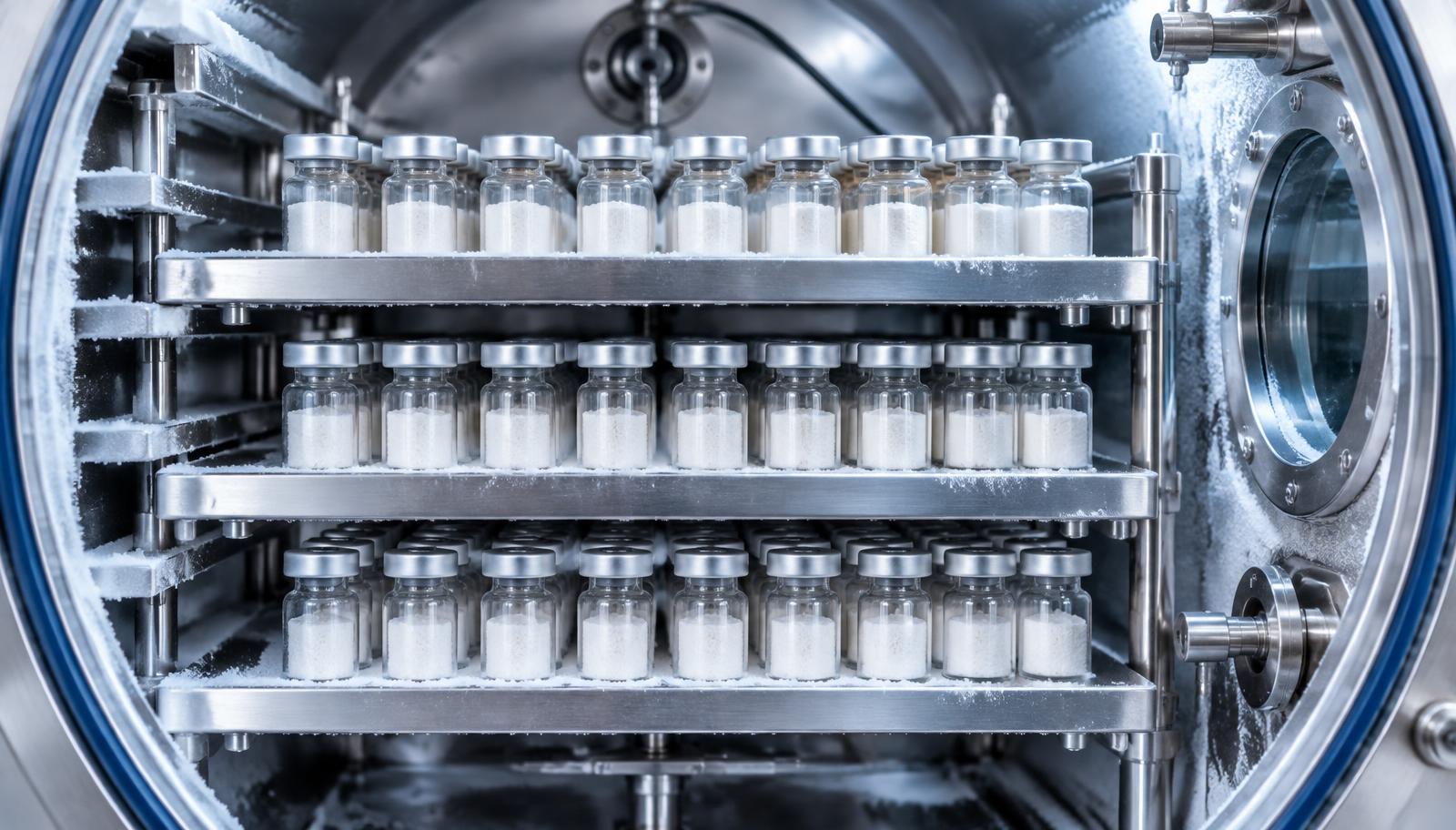
A solution contains molecules dispersed in a liquid environment. Lyophilisation, also called freeze-drying, first freezes that environment and then removes much of its water without passing the ice through a bulk liquid phase. What remains is often a porous cake: a solid structure occupying roughly the space previously held by the frozen formulation. Its architecture reflects both the original ingredients and the history of freezing and drying.
For peptides and other experimental research materials, reducing water can help limit certain degradation pathways and reduce molecular mobility. That is a rationale for formulation development, not a guarantee that any dry sample is stable. The molecule, surrounding ingredients, process stresses and subsequent environment all matter. A useful way to understand lyophilisation is as the creation of a protective solid environment, rather than the simple subtraction of a solvent.
2. Freezing builds the future matrix
Freezing is not merely a preliminary cooling step. As ice forms, it generally excludes dissolved substances, concentrating them in the regions between ice crystals. These regions become the formulation matrix around the ice. Depending on composition and behaviour during freezing, that matrix may contain crystalline components, amorphous components or both. An amorphous material lacks long-range crystalline order; it can become glass-like when molecular movement is sufficiently restricted.
This separation changes the local environment experienced by a research molecule. Concentrations rise, some components may crystallise selectively, and local acidity can shift in certain formulations. Meanwhile, ice crystal size and arrangement help determine the pore network left after sublimation. Formulation ingredients may provide bulk or help protect sensitive molecules, but their usefulness is specific to the system. An ingredient that supports one peptide formulation need not behave identically in another.
3. Primary drying: ice leaves as vapour
During primary drying, ice sublimes: water passes directly from solid to vapour. Reduced chamber pressure supports this transition, while heat supplies the energy it requires. The vapour moves through the developing dry layer and towards a colder condenser, where it is captured. Drying therefore involves coupled heat and mass transfer. Vacuum alone does not explain the process, and the temperature of the material is not necessarily the temperature of the supporting shelf.
- Heat must reach the frozen material to sustain sublimation, while the product remains within the structural limits of its formulation.
- Water vapour must escape through pores; resistance can increase as the dried layer becomes thicker.
- The condenser provides a cold destination for the water vapour removed from the material.
- Vial position, fill geometry and formulation can influence drying behaviour, so a visually uniform batch need not have an identical thermal history everywhere.
4. Collapse marks a structural limit
A frozen formulation has limits to the conditions under which its emerging structure remains intact. In an amorphous matrix, excessive molecular mobility can cause softening and collapse during drying. Crystalline systems may instead be constrained by melting behaviour, including eutectic transitions where relevant. Collapse can reduce porosity and alter drying behaviour. It does not automatically establish chemical degradation, just as an elegant, intact cake does not prove molecular integrity or acceptable residual moisture.
Editorial caution: these principles describe formulation science, including experimental research, not evidence of suitability for human use. The cited process references do not establish that any particular peptide formulation has been validated.
5. Secondary drying targets remaining water
Once the ice has been removed, water still remains associated with the solid matrix. Secondary drying primarily addresses this non-ice water through desorption: water molecules leave surfaces and other sites of interaction within the formulation. Its dominant mechanism therefore differs from ice sublimation, although processes can overlap during the transition. The purpose is to reach a moisture state appropriate to the material, without exposing it to stresses that undermine the intended benefit.
6. Residual moisture needs interpretation
Residual moisture is the water left after drying, not necessarily evidence of an unfinished process. In amorphous matrices, water can act as a plasticiser, increasing molecular mobility and lowering the glass-transition temperature. Yet the lowest possible water content is not automatically best for every formulation. Meaningful assessment connects moisture measurements with molecular integrity, physical state and stability observations over time. Shelf life cannot be read from a cake photograph or inferred from the word lyophilised.
7. Explore the science behind the dry material
The strength of lyophilisation lies in how its stages work together: freezing shapes the matrix, primary drying creates porosity, and secondary drying adjusts the remaining water. This framework makes technical descriptions easier to interpret without mistaking a processing method for proof of performance. To continue exploring the science of research materials, visit Synedica Europe's research library and documented catalogue, distinguishing general explanations from information documented for an individual material.
Related products
See allFrequently asked questions
Is lyophilisation the same as ordinary drying?
No. Its defining stage removes ice by sublimation from a frozen material. Ordinary evaporative drying removes liquid water as vapour. Secondary drying then addresses water remaining in the lyophilised matrix.
Can the appearance of a cake confirm its quality?
Appearance can reveal visible structural differences, but it cannot establish identity, purity, molecular integrity or moisture content. Those questions require appropriate analytical evidence rather than visual inspection alone.
Does a dry peptide automatically have a long shelf life?
No. Stability depends on the peptide, formulation, processing history and storage environment. A shelf-life statement needs supporting evidence for the specific material; freeze-drying alone does not supply that evidence.
Sources and further reading
About the author
Synedica Quality & Compliance Desk
Quality assurance and compliance team
The Quality & Compliance Desk maintains Synedica Europe's authentication programme, packaging standards and European distribution documentation, and reviews every editorial page that touches handling, storage or regulatory topics.
- Owns the Synedica anti-counterfeit programme (scratch QR, holographic seal, NFC)
- Maintains batch traceability and packaging specifications
- Reviews all handling, storage and shipping guidance before publication
Continue reading
See all
How to Reconstitute Lyophilised Peptides
Most peptide losses happen in the ninety seconds after the diluent goes in. A slower technique protects the material.
Peptide Shelf Life and Stability
Shelf life is a function of chemistry and storage, not a number printed on a box. Here are the pathways that actually consume a vial.
Peptide Packaging Science: Barriers Against Light, Moisture and Oxygen
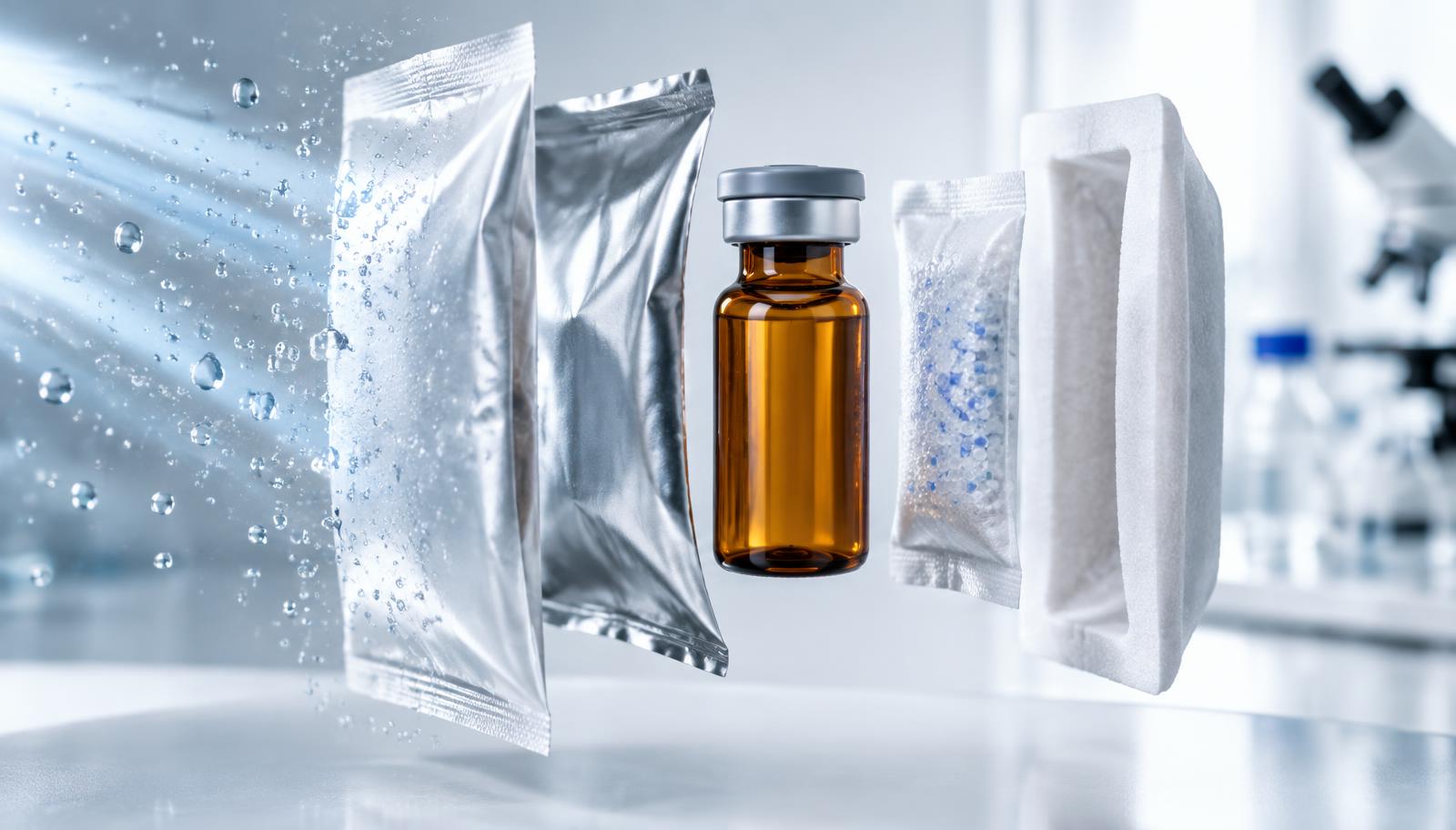
For experimental peptide research, packaging is part of the stability question, not simply a protective shell. Glass, closures, headspace and outer layers work together, and their contribution becomes meaningful when the complete configuration is evaluated over time.