

From Manual Synthesis to Digital Platforms: How Peptide Science Evolved
Peptide science advanced through successive changes in what researchers could build, measure and compare. From early synthetic chemistry to connected laboratory platforms, its history is one of expanding experimental possibilities—not a shortcut from a manufactured molecule to a clinically validated intervention.
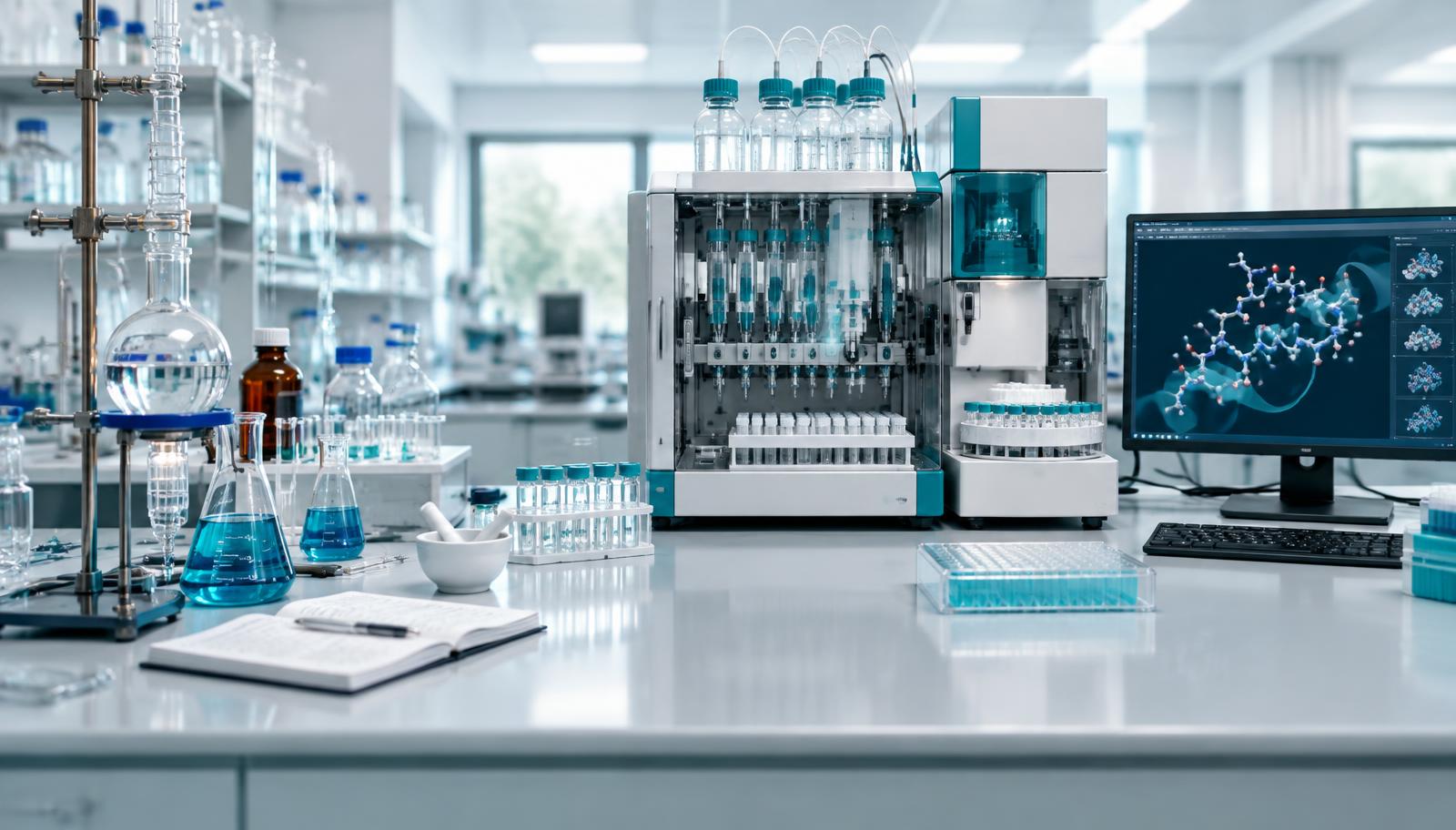
The foundations: Fischer and du Vigneaud
At the beginning of the twentieth century, Emil Fischer helped establish the chemical foundations of peptide research. His work on amino acids and their linkage into peptides connected the study of proteins with laboratory synthesis. The central idea was powerful: molecules related to biological structures could become objects of deliberate chemical construction. Yet assembling a defined sequence remained demanding, with substantial manual work between successive reactions.
In the early 1950s, Vincent du Vigneaud and colleagues established the structure of oxytocin and achieved its synthesis. This was a landmark because it brought structural understanding and chemical preparation together for a peptide hormone. It did not make every peptide straightforward to manufacture. Rather, it demonstrated how precise chemistry could address a biologically significant molecule while exposing the practical challenge of extending such work to other sequences.
Merrifield changed the organisation of synthesis
Bruce Merrifield’s introduction of solid-phase peptide synthesis, or SPPS, in 1963 changed how peptide assembly could be organised. Instead of keeping every intermediate freely dissolved, the growing chain remained attached to an insoluble support during assembly. This made it easier to separate the supported material from excess reagents and soluble by-products. The Nobel Prize in Chemistry awarded to Merrifield in 1984 recognised his method for chemical synthesis on a solid matrix.
The historical importance of SPPS lies partly in this separation of repetitive operations from repeated isolation of individual intermediates. It created a framework suited to mechanisation and, later, programmable instruments. But the support did not abolish difficult chemistry. Incomplete reactions, unwanted products and sequence-dependent behaviour remained relevant. SPPS was an enabling architecture, not a guarantee that every designed peptide would emerge with the intended identity and quality.
Automation made repetition programmable
Automated synthesis instruments translated a repetitive chemical workflow into operations that could be scheduled and recorded. Researchers could spend less attention on routine handling and more on experimental design, troubleshooting and interpretation. Alongside improvements in chemistry, this supported the preparation of collections of related peptides. Such collections made it more practical to investigate how changes in a sequence influence measurable properties under defined experimental conditions.
A digital platform is broader than an automated synthesiser. It can connect sequence designs, instrument records, sample identifiers and analytical results within a traceable research workflow. These connections matter because producing more samples is useful only if researchers can establish what each sample represents. Integration varies between laboratories: some systems exchange structured data, while others still depend on manual transfers and careful reconciliation of records.
- Sequence records distinguish the intended design from later revisions and related experimental variants.
- Synthesis records preserve the link between an experimental plan and its actual execution.
- Analytical records associate observations with an identified sample and a stated measurement method.
- Versioned datasets help researchers compare results without losing the history of corrections or exclusions.
Analytics made products easier to question
The evolution of peptide science is as much a history of measurement as of synthesis. Chromatographic methods help separate components in a sample and describe its analytical profile. Mass spectrometry provides information about molecular mass and, with suitable approaches, structural features. Used together, analytical methods can strengthen the assessment of whether a preparation is consistent with the intended product. No single measurement answers every question about a sample.
An apparently simple purity value depends on the method used and the components it can detect or resolve. Likewise, observing an expected mass is not equivalent to establishing every structural detail. These distinctions become especially important when datasets are compared across instruments or laboratories. A digital record is most informative when it preserves measurement context rather than reducing a complex analysis to an isolated pass-or-fail label.
Computation adds hypotheses, not clinical proof
Computational tools now help researchers organise sequence space, model selected properties and prioritise candidates for experimental study. Machine learning can search for patterns in existing data, while other modelling approaches explore relationships between structure and behaviour. Their usefulness depends on the question, the data and the limits of the model. Predictions are starting points for investigation; laboratory results may support them, qualify them or reveal where their assumptions fail.
Editorial distinction: a research platform may demonstrate synthesis capability, analytical characterisation or performance in an experimental assay. Those achievements do not establish clinical safety or efficacy. Findings from computational models, cell systems or other preclinical settings require interpretation within their specific context. Clinical validation remains a separate evidential task involving appropriately designed human studies.
Explore the history through documented research
The most encouraging thread in this history is not the disappearance of uncertainty, but the growing ability to investigate it systematically. Chemistry, automation, analytics and computation offer complementary ways to ask better questions. To continue exploring this field, visit Synedica Europe’s research library and documented catalogue, keeping the distinction between experimental research and clinical evidence in view.
Related products
See allFrequently asked questions
Did automated instruments replace the chemist?
No. Automation changed the distribution of work. Instruments can execute programmed operations, but researchers still define the scientific question, assess chemical constraints, interpret analytical findings and investigate unexpected results. More automation increases the importance of reliable records and informed oversight.
Is a digital peptide platform necessarily an AI system?
No. A platform may simply connect design files, instrument outputs and sample records. Artificial intelligence is an optional component, not the defining feature. The essential digital contribution is making information easier to trace, compare and reuse without losing its experimental context.
Why distinguish analytical quality from clinical validation?
They address different questions. Analytical characterisation concerns the material examined and what measurement methods reveal about it. Clinical validation concerns evidence in people. A well-characterised research peptide can be useful experimentally without providing evidence of clinical safety or efficacy.
Sources and further reading
About the author
Synedica Research Desk
Scientific content team
The Synedica Research Desk writes and maintains the technical library behind the Synedica Europe catalogue. The team compiles publicly available literature, supplier documentation and analytical data into plain-language explainers for laboratory and research audiences.
- Reviews certificates of analysis supplied with every Synedica batch
- Sources claims from peer-reviewed literature and regulator publications
- Publishes review dates and correction notes on every article
Continue reading
See all
What Are Research Peptides? A Plain-English Guide
Peptides sit between amino acids and proteins. Here is what that means in practice, how research-grade material is produced and how to read what is printed on the vial.

How Peptide Research Moves From Bench to Regulator
Understanding the pipeline explains why 'in research' and 'approved' are separated by years and by an enormous amount of evidence.
The Future of Peptide Discovery: Automation, Synthesis and AI
The next chapter in peptide discovery is not simply about making more molecules. It is about connecting design, synthesis, measurement and learning so that each experiment informs the next. Automation and AI can strengthen this cycle, provided the evidence remains traceable and experimental validation stays central.