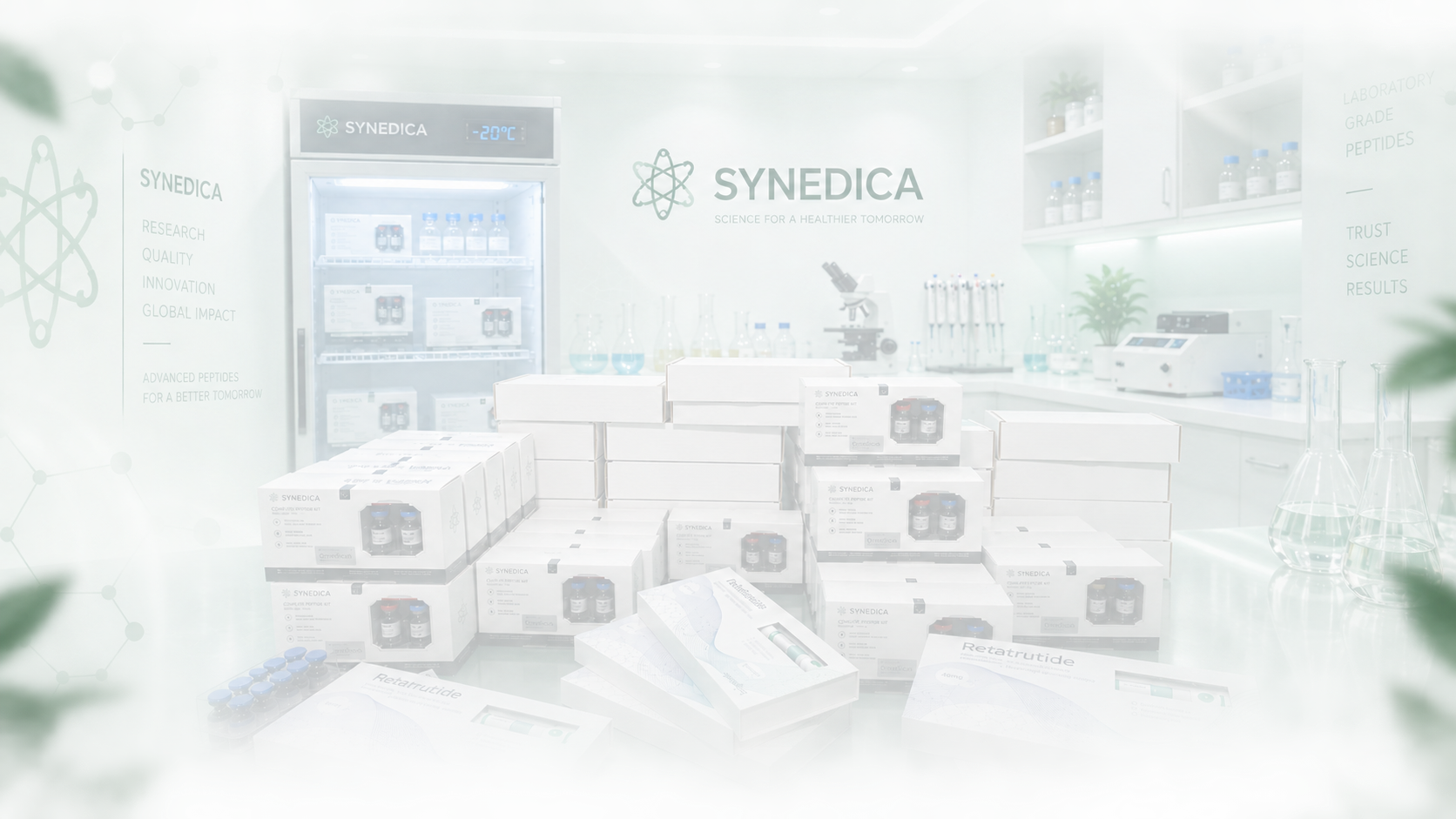

How to Store Research Peptides
Dry, cold and dark, opened as few times as possible. Everything else is detail — but the detail is where material is lost.

Peptide degradation is driven by water, oxygen, light, heat and repeated temperature cycling. Storage practice is simply the business of limiting all five.
Lyophilised material
- Keep vials sealed in the original protective packaging until use.
- Store cold and dark, following the condition printed on the vial label.
- Allow the vial to reach room temperature before opening to prevent condensation.
- Keep desiccant in the storage container where the documentation calls for it.
Reconstituted solutions
Once in solution, hydrolysis and oxidation start. Solutions are stored refrigerated for short holds and frozen in single-use aliquots for longer ones. Each freeze–thaw cycle costs material, so plan aliquot volumes around how you actually work, not around the vial size.
Sequences that need extra care
Sequences containing cysteine, methionine or tryptophan are prone to oxidation; those containing asparagine or glutamine are prone to deamidation at higher pH. Where the documentation flags a sensitivity, reduce headspace and protect from light.
Shipping is not storage
Synedica ships lyophilised material in protective, tamper-evident packaging rather than refrigerated boxes — dry peptides tolerate transit at ambient temperature, and protection against crushing and light matters more over a short journey. Put material into its proper storage condition on arrival, not at the end of the day.
Keep a log
Record compound, batch number, arrival date, reconstitution date, diluent and concentration. When a result looks unusual months later, the log is what tells you whether the material or the method changed.
Related products
See allFrequently asked questions
Can lyophilised peptides be stored at room temperature?
Short periods during transit are normal. For anything beyond that, follow the labelled cold storage condition.
How many freeze–thaw cycles are acceptable?
As few as possible. Aliquot on first thaw so that each subsequent use touches a fresh tube.
Does frost inside the vial matter?
Yes — visible moisture in a lyophilised vial suggests the seal or the temperature control has failed. Do not use material you cannot account for.
Sources and further reading
About the author
Synedica Quality & Compliance Desk
Quality assurance and compliance team
The Quality & Compliance Desk maintains Synedica Europe's authentication programme, packaging standards and European distribution documentation, and reviews every editorial page that touches handling, storage or regulatory topics.
- Owns the Synedica anti-counterfeit programme (scratch QR, holographic seal, NFC)
- Maintains batch traceability and packaging specifications
- Reviews all handling, storage and shipping guidance before publication
Continue reading
See all
Peptide Shelf Life and Stability
Shelf life is a function of chemistry and storage, not a number printed on a box. Here are the pathways that actually consume a vial.
How to Reconstitute Lyophilised Peptides
Most peptide losses happen in the ninety seconds after the diluent goes in. A slower technique protects the material.
Shipping and Customs in Europe: What to Expect
Dispatch point decides almost everything about the delivery experience. Here is how European distribution actually works.