

How Formulators Work With Peptides in Modern Cosmetics
A peptide is not a finished cosmetic. Between selecting a raw material and documenting a market-ready formula, formulators must consider molecular stability, the surrounding vehicle, microbial protection and packaging. The interesting science lies in how these decisions work together, rather than in any single ingredient promise.

Start with the material, not the ingredient story
Peptides are chains of amino acids, but that description covers materials with very different formulation behaviour. Sequence, chain length, chemical modifications and the form supplied can influence solubility and stability. A lipid-linked peptide, for example, cannot automatically be handled like an unmodified, water-soluble peptide. Formulators therefore begin with the identity and specifications of the actual raw material.
The supplied ingredient may also be a solution or dispersion containing solvents, salts and other components. Those components become part of the formula and its documentation. Useful supplier information includes composition, storage conditions, analytical identity and known compatibility limits. A trade name alone does not establish what remains intact after manufacturing or throughout the finished product's shelf life.
pH and water activity answer different questions
There is no universal ideal pH for every cosmetic peptide. Changing pH can alter electrical charge, solubility and susceptibility to particular degradation pathways. The relevant question is whether the selected peptide remains suitably characterised in the complete formula over time. A supplier's suggested range is a starting point for development, not a substitute for checking the finished system.
Water activity describes how available water is within a system; it is not simply the amount of water listed in a recipe. It matters when assessing microbial growth and can also affect chemical behaviour. Humectants and dissolved substances may change it, but their presence does not establish adequate preservation. An anhydrous format likewise needs assessment rather than an automatic assumption of stability.
Compatibility belongs to the whole formula
A peptide shares its environment with preservatives, surfactants, polymers, fragrances and other ingredients. Depending on its structure, interactions may change solubility, distribution or analytical recovery. Oxidation or other chemical changes may occur without an obvious colour or texture change. Conversely, a change in viscosity does not by itself demonstrate peptide degradation. Physical observations and chemical measurements answer complementary questions.
- Check whether the supplier's carrier introduces salts or solvents that affect the intended vehicle.
- Consider charge-related interactions with polymers and surfactants rather than relying on a blanket compatibility rule.
- Investigate sensitivity to oxygen, light or trace metals where the peptide's chemistry makes these relevant.
- Interpret changes in appearance alongside suitable analytical evidence, not as proof of molecular integrity.
Choose the vehicle before celebrating encapsulation
A serum, emulsion or gel provides more than a sensory identity. Its phases influence where ingredients reside, how they disperse and how they encounter other components. Manufacturing conditions also matter: exposure to heat, mixing and interfaces can affect sensitive materials. The development task is to establish a workable environment for the specific peptide without assuming that one texture is universally preferable.
Encapsulation can be investigated as a way to separate an ingredient from parts of that environment or modify its release. It also introduces questions about loading, leakage, carrier stability and measurement. Evidence from an experimental carrier system does not demonstrate the same behaviour in a finished cosmetic. Nor does encapsulation, by itself, establish delivery through skin or a visible benefit.
Preservation and packaging form a connected system
Microbial protection cannot be inferred from the word peptide, from a preservative appearing on the ingredient list or from a product looking unchanged. Formulators consider the whole composition, manufacturing hygiene and foreseeable use. Appropriate microbiological assessment, including preservation efficacy testing where relevant, addresses questions that chemical stability studies cannot answer. Maintaining the peptide and controlling contamination are distinct development objectives.
Packaging can influence exposure to air, light and contamination, while its materials can interact with the formula. An opaque container or airless dispenser may address particular design concerns, but neither guarantees stability or preservation. Evaluating the actual formula–package combination can reveal issues such as adsorption, dispensing changes or loss of water. Repeated opening and storage conditions also belong in the assessment.
Separate stability evidence from claim substantiation
A stable-looking product, an analytically detectable peptide and a substantiated cosmetic claim are three different propositions. Analytical work should distinguish the target material from relevant changes where needed; a broad signal may not establish that the original peptide remains intact. Physical stability observations help describe the product, but cannot independently demonstrate the ingredient's integrity or justify a claim about its effects.
Experimental biochemical assays, cell models and reconstructed skin systems can inform research questions. Their findings remain specific to the model, material and conditions studied. They should not be presented as established outcomes for people using a cosmetic. Claims about a finished product need relevant support, with attention to the tested formulation, endpoint and limitations rather than a simple transfer of an ingredient supplier's narrative.
Read documentation within its proper scope
Editorial note: the references provide regulatory context and ingredient information, not peptide-specific stability data or finished-product evidence. A CosIng entry is not, by itself, approval for a particular use or proof of performance. Sources: European Commission — cosmetic products legislation (https://single-market-economy.ec.europa.eu/sectors/cosmetics/legislation_en); CosIng — European cosmetic ingredient database (https://ec.europa.eu/growth/tools-databases/cosing/). Material-specific decisions require additional technical documentation and appropriate assessment.
Explore the science behind the documentation
Peptide formulation is a constructive exercise in connecting chemistry, product design and evidence. For further context, explore Synedica's research library and documented catalogue, keeping the distinction between ingredient information, experimental research and finished-product substantiation in view. That distinction makes technical reading more useful and comparisons more meaningful.
Related products
See allFrequently asked questions
Does every peptide need the same formulation pH?
No. Sequence, modifications and the surrounding formula can change how a peptide behaves. A useful pH range must be considered alongside solubility, chemical stability and the needs of other ingredients. There is no single range that establishes suitability for all cosmetic peptides.
Does encapsulation prove that a peptide reaches a particular skin layer?
No. Encapsulation describes a formulation approach, not an established delivery result. Carrier characterisation, release behaviour and evidence relevant to the finished product are separate questions. Experimental findings from one system cannot automatically be applied to another.
Why assess the product in its intended packaging?
The container is part of the product's storage and use environment. Light exposure, air exchange, dispensing and interactions with packaging materials may influence its behaviour. Testing an unpackaged laboratory sample cannot answer every question about the final formula–package combination.
Sources and further reading
About the author
Synedica Research Desk
Scientific content team
The Synedica Research Desk writes and maintains the technical library behind the Synedica Europe catalogue. The team compiles publicly available literature, supplier documentation and analytical data into plain-language explainers for laboratory and research audiences.
- Reviews certificates of analysis supplied with every Synedica batch
- Sources claims from peer-reviewed literature and regulator publications
- Publishes review dates and correction notes on every article
Continue reading
See all
Reading a Cosmetic Ingredient List (INCI)
The ingredient list tells you more than the front of the box — if you know where the 1% line sits.
How to Layer a Peptide Serum
Order matters less than consistency, but a few pairings really are worth separating. Here is a routine that works.
Signal, Carrier and Modulating Peptides: A Vocabulary for Cosmetic Formulation
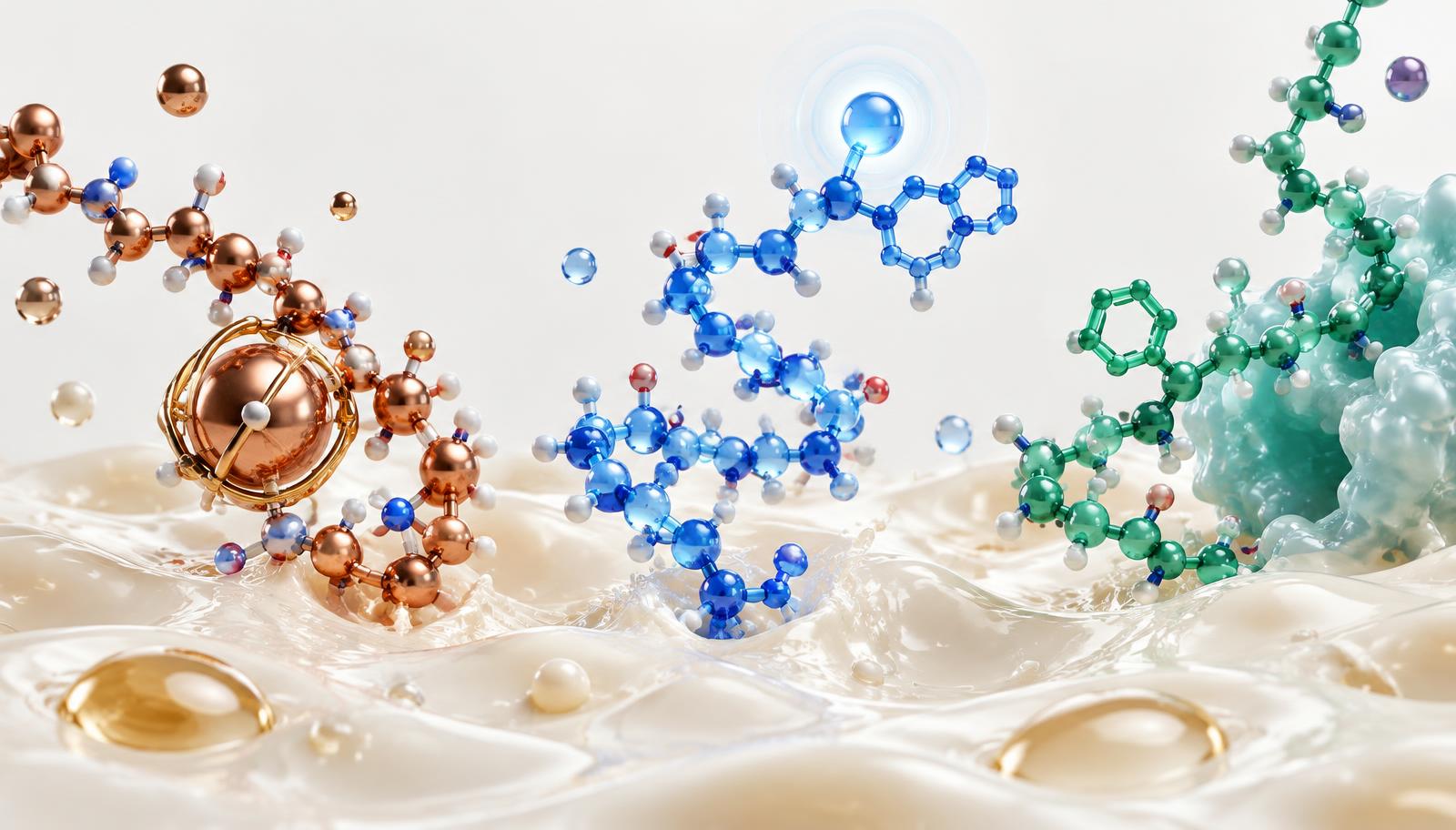
Signal, carrier and modulating peptides offer a useful vocabulary for discussing cosmetic ingredients. These labels describe proposed roles, not guaranteed results. Understanding their boundaries helps formulators and informed readers connect molecular identity, experimental observations and finished-product evidence without confusing a plausible mechanism with a demonstrated cosmetic benefit.