

Precision Technology for Research: From Measurement to Controlled Dispensing
Precision in liquid handling is not a single instrument specification. It emerges from measurement, calibration, liquid behaviour and the way researchers record their work. For experimental peptide research, understanding those connections helps turn a nominal volume into a more interpretable and reproducible laboratory operation.
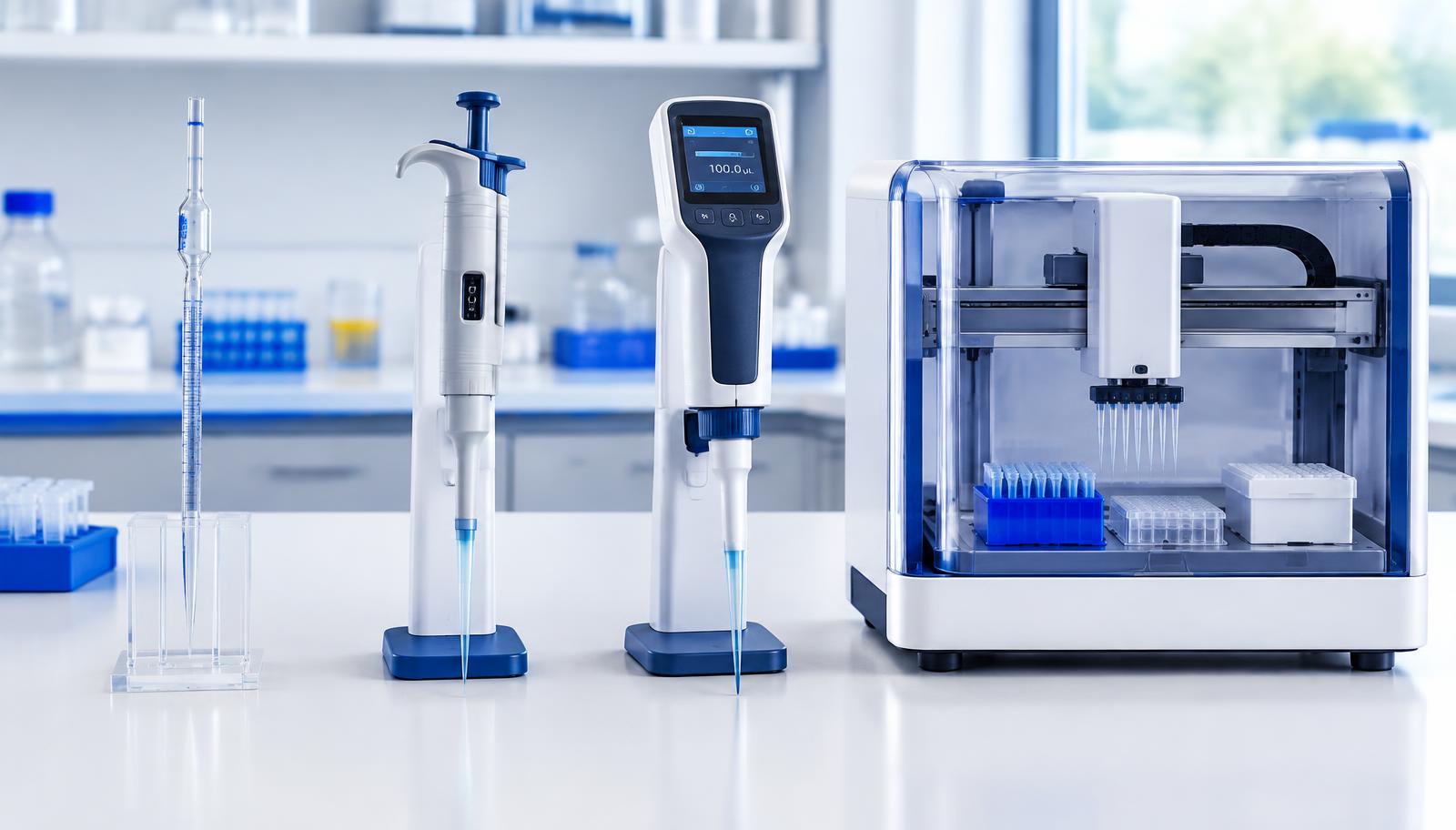
A displayed volume is only the starting point
A dispenser setting describes an intended delivery, not independent proof of the volume transferred. The result depends on the instrument, its operating range, the liquid and the surrounding conditions. This distinction matters when comparing peptide experiments: two records can show the same nominal volume while concealing different measurement conditions. Precision technology is therefore best understood as a system linking a physical transfer to evidence about that transfer, rather than as a display with more decimal places.
Repeatability describes the agreement between repeated measurements under specified conditions. Systematic error concerns a consistent departure from a reference value. Neither should be confused with display resolution. An instrument may produce closely grouped results that remain offset from the intended volume. Measurement uncertainty provides another essential perspective: it expresses the dispersion reasonably attributable to the measured quantity, making clear that a reported value is not an exact, context-free truth.
Calibration connects settings to measurement evidence
Calibration establishes a relationship between instrument indications and reference values under stated conditions. It is distinct from adjustment, which changes instrument behaviour, and from a routine check against an acceptance criterion. For volumetric apparatus, gravimetric evaluation can relate delivered liquid mass to volume using the relevant density and corrections. Balance performance, environmental conditions and evaporation can influence that evaluation. A calibration record is consequently most informative when its scope, conditions, uncertainty and instrument identity are available, rather than only a pass label.
Reference framework: ISO 8655 — piston-operated volumetric apparatus (https://www.iso.org/standard/75206.html); NIST — laboratory metrology resources (https://www.nist.gov/calibrations). These sources provide a standards and metrology context. Their inclusion does not establish that a particular device has been calibrated, certified or assessed against every applicable requirement.
Positive displacement changes the liquid interface
In an air-displacement design, an air cushion separates the piston from the liquid. In positive-displacement systems, the moving piston acts directly on the liquid within a suitable capillary or cylinder. Removing that air cushion changes how liquid properties affect delivery. Positive displacement can be useful for some viscous or volatile research liquids, but suitability remains dependent on the specific design, compatible materials and documented operating limits. It is not a universal guarantee of better results.
For experimental peptide solutions, delivered volume is only part of the material balance. Adsorption to contact surfaces, solvent composition and sample stability may also affect what reaches the receiving vessel. A mechanically consistent transfer does not demonstrate that peptide concentration or integrity remained unchanged. This is why an informative equipment comparison considers the entire liquid-contact path and the experimental matrix, rather than treating the displacement mechanism as a complete description of performance.
Non-contact automation adds control, not certainty
Non-contact dispensing transfers liquid without the dispensing outlet touching the receiving liquid or vessel. Depending on the technology, this can support repeated delivery into research plates while limiting some forms of direct contact. However, droplet formation, positioning, wetting and evaporation remain relevant. Automation can repeat a programmed action consistently, including an unsuitable one. Its research value therefore depends on documented suitability for the liquid and vessel, appropriate performance evidence and a clear account of exceptions, not simply on removing manual handling.
Traceable settings need usable instruments
Digital controls can make settings easier to retain, but a saved number is not metrological traceability. Traceability links a measurement result to a reference through a documented, unbroken chain of calibrations, each contributing uncertainty. An audit trail instead records actions and changes. Both are valuable, but they answer different questions. Ergonomics also belongs in this discussion: readable displays, manageable operating forces and clear adjustment controls can support consistent use without demonstrating measurement performance on their own.
- Instrument identity and configuration distinguish a recorded setting from a generic equipment description.
- The selected volume, operating mode and relevant software version make a digital record more interpretable.
- Liquid and vessel descriptions preserve context that a volume field alone cannot capture.
- Calibration references and performance-check records connect everyday use with measurement evidence.
- Recorded changes and exceptions help explain differences between otherwise similar research runs.
Editorial caution: these principles concern laboratory research, including experimental peptide workflows. They are not human administration instructions. Neither automation, positive displacement nor a calibration record alone establishes suitability for a different application or proves the validity of an experimental conclusion.
Explore the documented research context
The encouraging development is not that one technology can remove every source of variation. It is that measurement, control and documentation can increasingly be considered together. A well-described research setup makes it easier to distinguish an instrument setting from a measured result, and a repeatable transfer from a scientifically supported interpretation. That distinction gives both manual and automated tools a constructive place in experimental work.
Explore Synedica’s research library and documented catalogue for further context on laboratory research tools, their stated characteristics and the terminology used to describe them.
Related products
See allFrequently asked questions
Does a finer digital display mean a more accurate delivery?
Not necessarily. Display resolution indicates how finely a setting or reading is presented. Delivery performance depends on the instrument and conditions and needs suitable measurement evidence. Additional digits do not, by themselves, demonstrate lower systematic error, better repeatability or smaller uncertainty.
Is positive displacement always preferable for peptide research?
No. It may suit particular liquid properties, but the choice also depends on volume range, contact materials, solvent compatibility and the experimental matrix. The relevant question is whether documented performance supports the intended research application, not whether one mechanism is universally superior.
What separates an audit trail from metrological traceability?
An audit trail records who changed or used a setting and, where supported, when that happened. Metrological traceability connects a measurement result to a reference through documented calibrations and their uncertainties. A useful research record can include both without treating them as interchangeable.
Sources and further reading
About the author
Synedica Research Desk
Scientific content team
The Synedica Research Desk writes and maintains the technical library behind the Synedica Europe catalogue. The team compiles publicly available literature, supplier documentation and analytical data into plain-language explainers for laboratory and research audiences.
- Reviews certificates of analysis supplied with every Synedica batch
- Sources claims from peer-reviewed literature and regulator publications
- Publishes review dates and correction notes on every article
Continue reading
See all
Insulin Syringe Sizes Explained: Gauge, Length and Volume
Three numbers on the wrapper — volume, gauge and length — decide how accurately you can measure a small volume.

Avoiding Contamination on the Bench
Contamination rarely announces itself. It shows up later as an unexplained result — which is why technique is cheaper than repeating the work.

The Future of Peptide Discovery: Automation, Synthesis and AI
The next chapter in peptide discovery is not simply about making more molecules. It is about connecting design, synthesis, measurement and learning so that each experiment informs the next. Automation and AI can strengthen this cycle, provided the evidence remains traceable and experimental validation stays central.