

Quality in Transit: Designing Logistics for Sensitive Research Materials
For sensitive research materials, transport is part of the quality story, not an interval outside it. Route assessment, qualified packaging, meaningful monitoring and documented handovers can turn an uncertain journey into an interpretable record. The objective is not simply arrival, but evidence that supports an informed assessment on receipt.
Start with the material, not the delivery promise
A shipment may arrive on time without providing enough information to assess its condition. Conversely, a delay does not by itself demonstrate damage. Logistics quality depends on linking the material’s documented transport requirements to the conditions it actually encounters. For experimental research materials, including research peptides, those requirements should reflect the specific material and presentation. A broad description such as “temperature-sensitive” is not a substitute for a supported transport range or relevant stability information.
This is a quality-design question rather than a consumer guide to shipping or customs. The central issues are exposure, uncertainty and accountability. Transport arrangements should make clear what conditions are intended, what evidence will be available and who is responsible for reviewing discrepancies. Where supporting information is limited, that limitation belongs in the assessment rather than being concealed behind a familiar packaging format.
Assess the route as a sequence of exposures
A route is more than the distance between dispatch and receipt. Collection, sorting, temporary storage, transfers and the final handover can create different exposure conditions. Risk assessment considers both the expected journey and credible disruptions. Seasonal heat or cold, weekend holding and missed connections matter because they can change the duration and severity of exposure beyond what a headline transit time suggests.
- Duration: expected transit time, plausible delays and periods when the shipment may be held without active oversight.
- Environment: anticipated temperature conditions, exposed transfer points and the protection available during temporary holding.
- Handling: the number of transfers, potential physical stresses and any restrictions relevant to package orientation or integrity.
- Visibility: gaps in tracking, responsibility at each handover and access to records when an unexpected event occurs.
Qualified packaging answers a defined question
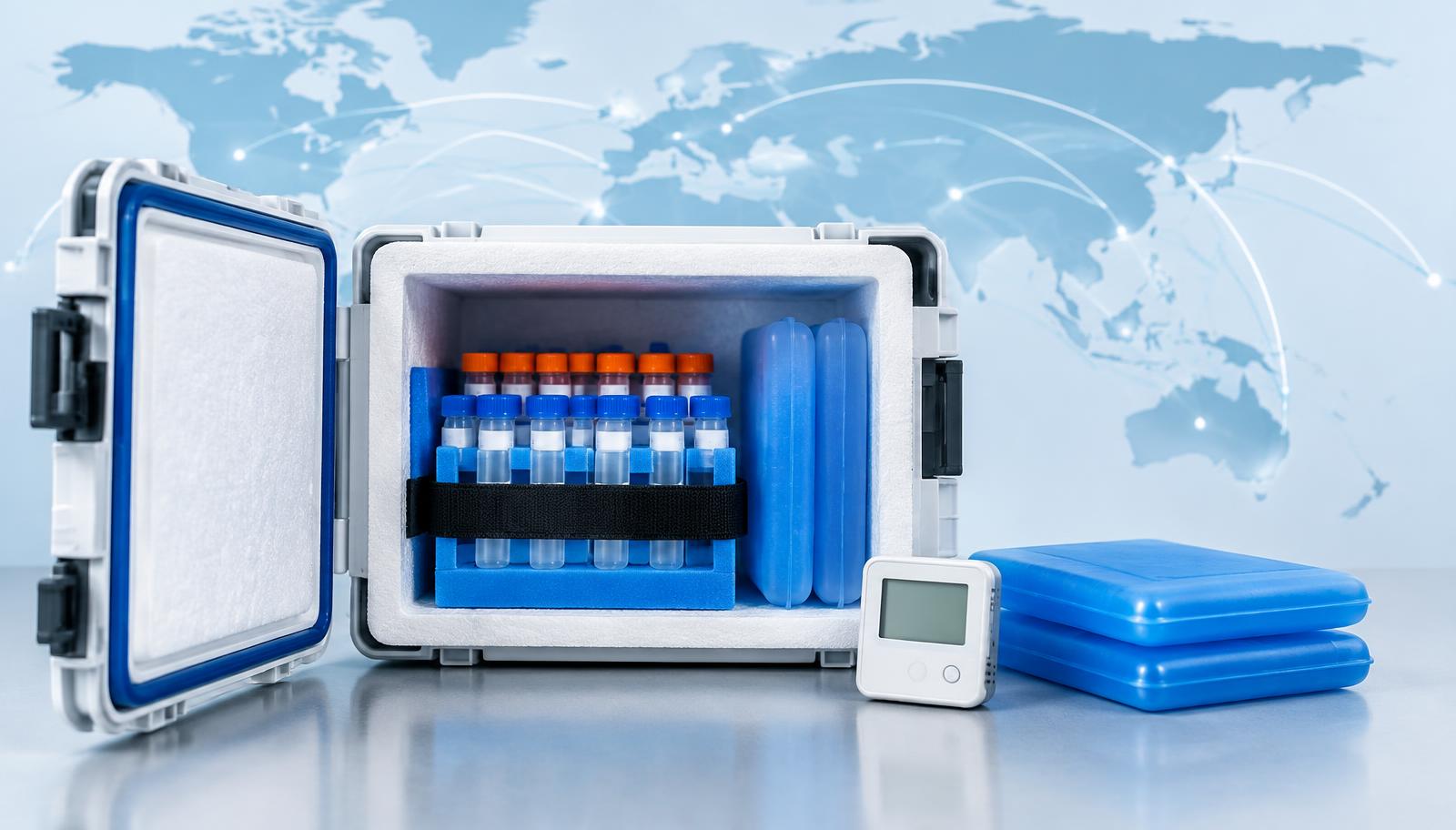
An insulated container is not inherently suitable for every sensitive material. Packaging qualification provides documented evidence that a defined configuration can meet specified requirements under evaluated conditions. Its meaning depends on the conditions assessed: the external temperature profile, duration, payload arrangement and thermal components. A qualification result supports the configuration examined; it does not automatically cover every combination of container, contents and route.
Changes can therefore matter even when the outer box looks identical. A different payload, altered internal arrangement or substituted thermal component may affect performance. More cooling is not always more protective, particularly where freezing is a concern. Good design connects the packaging evidence to the intended journey and keeps the relevant configuration identifiable, without presenting insulation or cold packs as a universal guarantee.
Make temperature records interpretable
A data logger provides a record from its measurement location, not direct proof of every vial’s condition. Interpretation depends on its identity, calibration status, measurement capability, recording interval and position within the package. The record also needs to be associated with the correct shipment and a clear time reference. Missing readings, an uncertain start time or an unexplained interruption reduce what can be concluded. Monitoring is most useful when the measurement strategy relates to the packaging assessment, rather than merely producing a graph after arrival.
Review excursions without jumping to conclusions
A temperature excursion is a departure from an established limit, not an automatic verdict on material integrity. Review considers the magnitude and duration of the departure, the reliability of the record and available material-specific stability evidence. Previous known exposures may also be relevant. A normal-looking package cannot settle these questions, and a single alarm rarely provides the whole answer. Where evidence is insufficient, the defensible outcome may remain uncertainty rather than an unsupported decision to accept or reject.
Editorial note: WHO and European guidance offer useful transport-quality principles for medicinal products; they do not automatically establish suitability or legal requirements for every experimental research material. Sources: WHO — qualification of shipping containers (https://www.who.int/publications/m/item/annex-9-model-guidance-for-the-storage-and-transport-of-time-and-temperature-sensitive-pharmaceutical-products); European Commission — good distribution practice guidelines (https://health.ec.europa.eu/medicinal-products/eudralex/eudralex-volume-4_en). These references are a framework for discussion, not evidence that a particular shipment or supplier meets a standard.
Connect custody with the condition record
Chain of custody establishes the documented sequence of possession and transfer. Useful records connect shipment identifiers, material or batch references, responsible parties, handover times and receipt observations. A seal or package identifier can help link the physical shipment to that record, but neither proves chemical integrity. Likewise, a delivery signature establishes a handover more readily than it establishes acceptable transport conditions. Custody and environmental monitoring answer related but different questions.
The strongest record allows discrepancies to be reconstructed without relying on memory. Logger files, package observations and communications about delays become more informative when linked to the same shipment. Responsibility for reviewing anomalies should also be visible. Over time, recurring gaps can inform route or packaging reassessment, making logistics quality a learning process rather than a one-off declaration.
Explore the evidence behind research logistics
Well-designed logistics cannot remove every uncertainty, but it can make uncertainty visible and manageable. Material requirements, packaging evidence, monitoring and custody records work best as one connected account. To continue exploring the context for experimental research materials, visit Synedica’s research library and documented catalogue.
Related products
See allFrequently asked questions
Does a logger within range prove that the material is unchanged?
No. It documents conditions at the sensor’s location within the limits of the measurement system. It does not directly assess chemical identity, purity or every possible stress. Its value depends on the packaging context, record completeness and the material-specific evidence available.
Is the fastest route always the lowest-risk route?
Not necessarily. Fewer hours in transit may be helpful, but transfer conditions, holding arrangements and predictability also matter. A route assessment considers the complete exposure pattern and credible delays, rather than treating advertised speed as a substitute for documented control.
Can the same qualified packaging be used for different materials?
Possibly, but suitability needs a documented basis. Relevant differences include transport requirements, payload characteristics and the conditions covered by qualification. A familiar container or previous successful delivery does not alone establish that a new material and journey are adequately covered.
Sources and further reading
About the author
Synedica Quality & Compliance Desk
Quality assurance and compliance team
The Quality & Compliance Desk maintains Synedica Europe's authentication programme, packaging standards and European distribution documentation, and reviews every editorial page that touches handling, storage or regulatory topics.
- Owns the Synedica anti-counterfeit programme (scratch QR, holographic seal, NFC)
- Maintains batch traceability and packaging specifications
- Reviews all handling, storage and shipping guidance before publication
Continue reading
See all
Shipping and Customs in Europe: What to Expect
Dispatch point decides almost everything about the delivery experience. Here is how European distribution actually works.
How to Store Research Peptides
Dry, cold and dark, opened as few times as possible. Everything else is detail — but the detail is where material is lost.

Peptide Packaging Science: Barriers Against Light, Moisture and Oxygen
For experimental peptide research, packaging is part of the stability question, not simply a protective shell. Glass, closures, headspace and outer layers work together, and their contribution becomes meaningful when the complete configuration is evaluated over time.